Indian healthcare doesn’t have a technology problem.
It has a translation problem.
We don’t lack ideas. What we lack are people willing to stay long enough in both worlds—clinical practice and innovation—to make those ideas actually work.
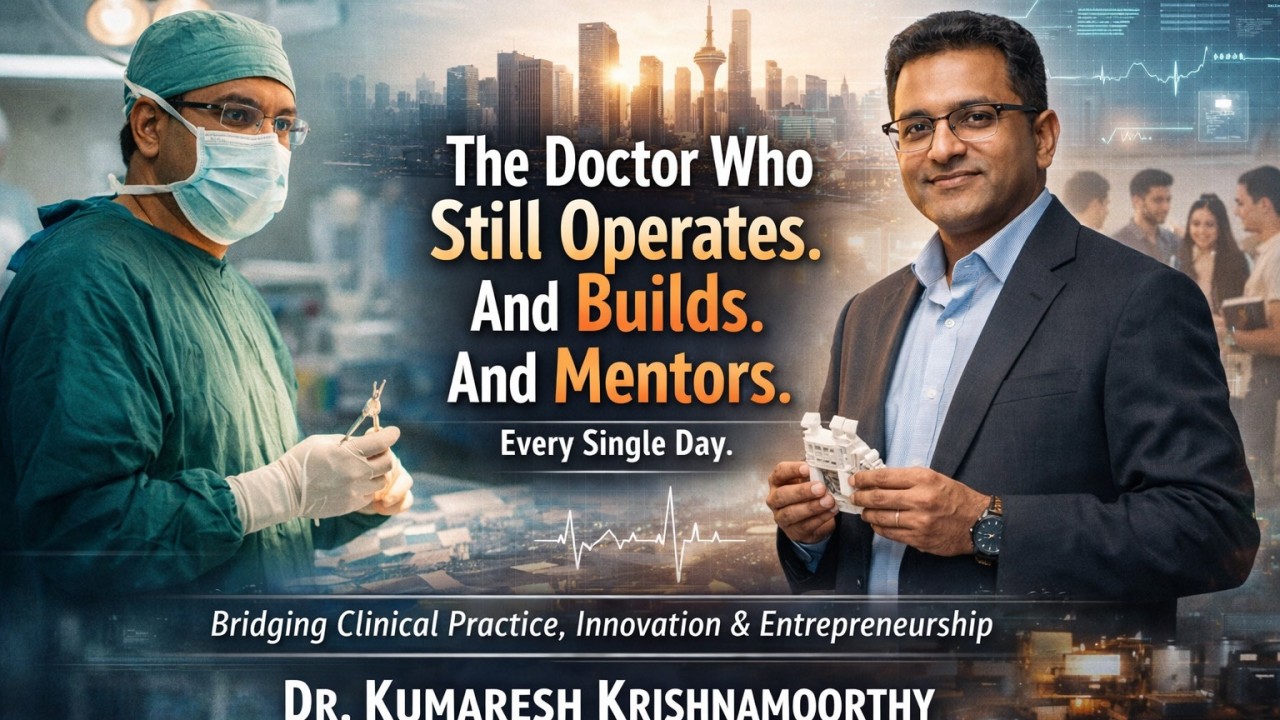
For over 25 years, I’ve made a deliberate choice: not to step away from the operating room, even while building products, mentoring founders, and working on healthcare innovation.
That decision has shaped everything I do.
I am an ENT / Head & Neck Onco surgeon. I see patients, perform surgeries, and experience the realities of Indian healthcare firsthand:
- Resource constraints
- Diagnostic gaps
- Communication breakdowns
The problems I work on are not abstract. They are the ones I encounter in my own practice.
And the solutions I build are not theoretical—they are tools I wish I had earlier.
That changes how you innovate.
Having trained and worked in the United States before returning to India, I’ve seen both extremes:
- Protocol-driven, resource-rich systems
- High-volume, resource-constrained environments
Most ideas work well in one. Very few survive in both.
That gap—between what works in theory and what survives in reality—is where many healthcare innovations fail.
Closing that gap has become central to my work.
I’ve taken ideas through the full journey:
Clinical observation → Product concept → Prototype → IP → Manufacturing → Scaling
Most of this has been built bootstrapped—by design.
Because in healthcare, scale without accessibility is not impact.
As a National Innovation Mentor under the Atal Innovation Mission (AIM), NITI Aayog—and through my work with innovation councils and funding panels—I’ve had the opportunity to:
- Mentor founders at early and growth stages
- Help shape innovation ecosystems at leading institutions
- Evaluate early-stage healthcare ventures
This has offered a broader perspective: not just what works—but what consistently fails.
And why promising ideas never make it to real-world adoption.
At ASTA Health Tech, we focus on a simple but powerful idea:
What matters most is not just the technology—it’s the model.
A practising clinician, professors, and a student I personally mentored—now an executive—built this together.
Students and interns are learning the real business of healthcare innovation alongside the science.
When clinicians, engineers, and institutions build together, outcomes change.
- Healthcare founders who want clinical depth alongside execution
- Institutions serious about building real innovation ecosystems
- Investors who understand long-term healthcare innovation
I prefer structured, high-commitment collaborations.
When I commit, I commit fully—because that is the only way to build something that lasts.
If you believe that real innovation comes from staying close to the problem—not stepping away from it—I would be interested in hearing from you.
— Dr. Kumaresh Krishnamoorthy